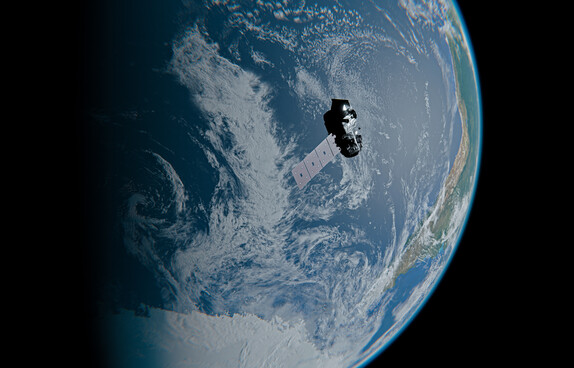
SpaceX's projected record-breaking IPO has obviously dominated headlines, but it’s also brought one of the technology industry’s most ambitious ideas into mainstream conversation – putting AI data centers into orbit. SpaceX is not the only organization thinking about infrastructures in space. Google’s Project Suncatcher has been exploring space-based compute and energy generation for the past year or so, Amazon already operates satellite-to-cloud ground station infrastructure to support pathways between orbital assets and terrestrial cloud environments, and the European Space Agency’s OFELIAS project is bringing together organizations like the German Aerospace Center and Internet Exchange operator DE-CIX to advance low-latency, laser-based satellite communications.
It’s no coincidence that some of the largest companies in the world are talking about orbital data centers. As demand for AI compute continues to accelerate, orbit potentially offers access to continuous solar power, natural radiative cooling, and room to scale beyond many of the physical constraints faced on Earth. Whether those ambitions are realized tomorrow or years from now, the idea has already graduated from sci-fi fantasy to real infrastructure planning.
What's striking, however, is that much of the mainstream debate still focuses on compute rather than connectivity. AI doesn't create value in a vacuum. Every model, application, and agent depends on the constant exchange of data between users, enterprises, cloud platforms, and other AI systems. Moving compute into orbit may help address power and cooling challenges, but it doesn't remove the need for fast, resilient, and predictable networking. In fact, it makes it all the more vital. Elon Musk himself has noted that orbital infrastructure is only a few milliseconds away, but latency is only part of the equation. Predictability and resilience matter just as much. Optical and laser-based links are far more preferable to radio communications and can deliver enormous bandwidth, but they have to contend with cloud cover, atmospheric turbulence, and the complexities of satellite-to-ground handovers, which is why the ESA’s OFELIAS initiative and others like it are so important.
Getting compute into orbit is one thing, but weaving together data centers on Earth, cloud platforms, edge locations, satellites, and eventually orbital compute into a single digital ecosystem capable of supporting AI at planetary scale is another thing entirely. The industry may be looking to the stars for the next big data center breakthrough, but the real test will be ensuring every one of those systems can communicate as seamlessly as if they were sitting in the same room. Wherever networks are created, interconnection should follow.